What Is AI Construction Management?
Across the industry, AI construction management is becoming a larger part of how teams think about coordination, but the underlying challenges of homebuilding have not changed. Schedules do not fail all at once. They slip in small ways such as a delayed trade, a missed approval, or a delivery that no longer lines up with the work on site. Each change may be manageable on its own, but across multiple jobs, those small gaps begin to compound.
For Builders, Suppliers, Manufacturers and Trades, keeping work moving is not just about execution. It is about maintaining alignment as conditions shift throughout the build. That often includes:
- Navigating disconnected updates across systems
- Confirming what has changed before work can continue
- Coordinating across teams to keep progress on track
This is where many delays begin, not from a lack of effort, but from the time it takes to identify changes and understand their impact across the build.
As AI becomes a more common topic across construction, the real question is not what it can do in theory, but whether it can help teams reduce the coordination work that slows projects down.
Why Builders Are Suddenly Hearing So Much About AI
Homebuilding has always depended on information moving between schedules, purchasing teams, Trades, Suppliers, and the field. What has changed is how quickly that information needs to move and how many people depend on it to keep work progressing.
Builders today are managing tighter schedules, higher job volume, and more coordination across teams than ever before. As those demands have increased, even small communication gaps can create delays that affect multiple jobs, crews, and deliveries.
The growing interest in AI reflects that reality. Builders are looking for faster ways to understand what is changing across their jobs and identify issues before they create larger disruptions.
Rather than adding another process to manage, AI can help teams spend less time tracking down information and more time responding to what is happening in the field. When schedules, purchasing activity, and job progress stay connected, teams have a clearer view of what needs attention and where action is required next.
The goal is not to change how homes get built. It is to help Builders keep pace with the volume of information required to keep jobs moving.
What AI Actually Means in a Construction Workflow
In construction, AI is most useful when it helps teams understand what has changed and what needs attention next.
That value does not come from replacing people or making decisions on their behalf. It comes from helping Builders, Suppliers, and Trades spend less time identifying problems and more time responding to them.
Most coordination issues start with a small change. A schedule shifts, a purchase order gets delayed, or a milestone is missed. On its own, each issue may seem manageable. Across multiple jobs, however, those changes can quickly affect other teams, deliveries, and timelines.
Traditionally, information about those changes is gathered through status meetings, follow-up calls, emails, reports, and manual checks across multiple systems. The challenge is not finding the information. It is finding it quickly enough to respond before it creates additional delays.
This is where AI can have the greatest impact. By helping teams surface issues sooner, understand how those issues affect the broader workflow, and focus attention where it is needed most, AI reduces much of the coordination work that slows projects down.
The goal is not to change how construction work gets done. It is to help teams keep schedules, purchasing activity, and job progress aligned as conditions change throughout the build.
The Three Places AI Has the Biggest Impact for Production Builders
AI has the greatest impact in parts of the workflow where coordination is constant and small issues can create downstream delays.
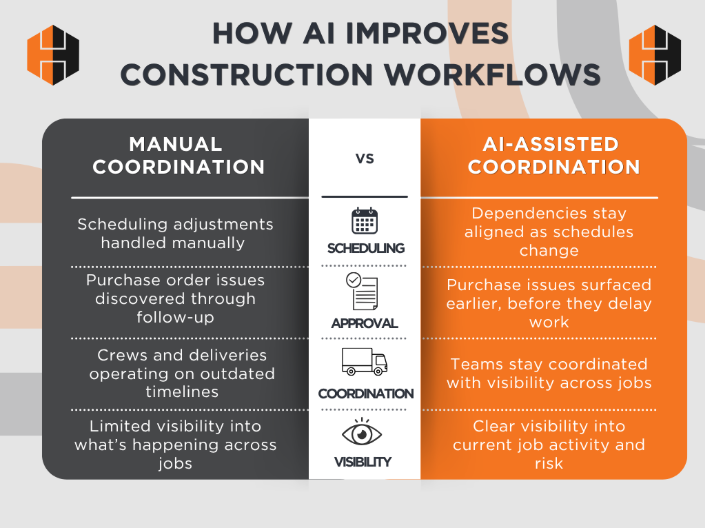
Scheduling is one of the clearest examples. A change to one task rarely stays contained. When a schedule shifts, dependent activities, trade timelines, and future milestones are often affected as well. Traditionally, teams spend time updating those connections manually and communicating changes across jobs. AI helps surface those impacts earlier, making it easier to keep schedules aligned as conditions change.
Purchasing and approvals present a similar challenge. Delays often begin with incomplete information, missed approvals, or inconsistencies that are not discovered until they start affecting the job. AI can help teams identify those issues sooner, reducing the amount of follow-up required to keep work moving and helping ensure purchasing activity stays aligned with job progress.
Trade and Supplier coordination is where the effects are often most visible. When teams are working from outdated information, crews may arrive before a job is ready, deliveries may miss installation windows, and schedule changes can create disruption across multiple Trades. AI helps bring those changes to the surface earlier so Builders, Suppliers, and Trades can adjust before small issues turn into larger delays.
The difference is easiest to see when comparing how work is typically managed today versus how it can be managed when teams have greater visibility into changing job conditions.
These are the types of coordination challenges AI is best suited to support. What it cannot do, however, is replace the processes and people responsible for keeping work moving.
What AI Doesn’t Do
AI does not replace experienced teams, nor does it eliminate the need for planning, communication, and coordination.
Homebuilding still depends on Builders, Suppliers, and Trades making decisions, solving problems, and keeping work moving as conditions change. AI can help teams identify issues earlier, but it cannot replace the people responsible for managing the work itself.
It also does not solve disconnected processes on its own. When scheduling, purchasing, and job activity operate in separate systems, gaps in visibility remain. AI may help teams recognize those gaps more quickly, but it cannot create alignment where connected workflows do not already exist.
The effectiveness of AI depends on the quality of the information behind it. The more accurately schedules, purchasing activity, and job progress reflect what is happening in the field, the more useful AI becomes in helping teams stay informed and focused on what needs attention.
How Hyphen Solutions Uses AI Across the Build Cycle
Hyphen Solutions approaches AI from a different starting point than many construction technology providers.
For decades, BuildPro and SupplyPro GM have supported the day-to-day coordination that takes place between Builders, Suppliers, Manufacturers, and Trades. Scheduling activity, purchasing decisions, deliveries, job progress, and trade coordination already move through the platform as work progresses.
That connected foundation is what makes AI useful. When information is captured as work is happening and shared across connected workflows, it reflects the current state of the build rather than a delayed version of it.
Many providers are adding AI features to systems that were never designed to connect the people responsible for building homes. Hyphen’s approach is different because Builders, Suppliers, and Trades are already working from connected workflows.
Dash, the AI assistant built into Hyphen products and powered by Hyphen Intelligence, helps teams access that information more easily. Instead of navigating reports or checking multiple systems, users can ask questions about what is happening across their jobs and quickly understand where attention is needed.
A Builder might want to know which jobs are beginning to fall behind schedule. A Supplier may need to understand which deliveries could be affected by changing job conditions. A Trade may be looking for jobs that require immediate attention from a crew or dispatcher.
Rather than spending time gathering information from multiple sources, teams can spend more time responding to issues, coordinating work, and keeping projects moving.
The result is not a different way of building homes. It is a faster way to understand what is happening across the build and act on it with greater confidence.
Questions to Ask Before Choosing an AI-Powered Platform
As AI becomes more common in construction software, it is important to look beyond feature lists and understand how the technology is being applied.
Some questions worth asking include:
- Is information captured where the work is happening?
- Are Builder, Supplier, and Trade workflows connected?
- Does the platform help reduce manual coordination?
- Can teams quickly access the information they need without building reports or searching through multiple systems?
- Does the technology help identify issues earlier so teams can respond before delays occur?
The value of AI is not measured by how much information it produces. It is measured by how effectively it helps teams understand what is changing and what needs attention next.
Frequently Asked Questions About AI Construction Management
AI construction management refers to the use of technology within construction workflows to help teams identify issues, recognize patterns, and improve coordination across scheduling, purchasing, and job activity.
It depends far more on how the AI is delivered than on the AI itself. A standalone AI platform usually carries its own license, an implementation period, integration work to connect it to scheduling and purchasing systems, and training time before teams get value from it. AI built into software a team already uses avoids most of that, because the workflows, the data, and the users are already in place. The more useful question when comparing options is not the license fee, but the total cost of getting to a reliable answer.
AI can help teams identify issues earlier, recognize when schedules and purchasing activity are beginning to fall out of alignment, and surface information that may require attention before delays affect other parts of the build.
Automation follows predefined rules to perform specific tasks. AI helps teams recognize patterns, identify issues, and understand what may require attention based on current activity across their jobs and workflows.
AI is not changing construction by replacing existing processes. Its value comes from helping teams keep up with the volume of information required to coordinate work across multiple jobs, teams, and partners.
Across Builders, Suppliers, Manufacturers, and Trades, the challenge has always been maintaining alignment as schedules, purchasing activity, and job conditions change. When information lags behind what is happening in the field, teams spend valuable time gathering updates, confirming details, and coordinating next steps.
AI helps reduce that gap. By helping teams see issues sooner and better understand how changes affect the broader workflow, it becomes easier to respond before small problems grow into larger delays.
The result is not a new way of working, it is a more responsive one.
With more than 126,000 users and over 18,000 residential Suppliers operating on the platform, Hyphen Solutions already reflects how work moves across the build. AI builds on that foundation by helping Builders, Suppliers, Manufacturers, and Trades stay connected to what is happening across their jobs and respond with greater confidence.