How AI Makes the Entire Homebuilding Network Smarter
Most conversations about AI in construction focus on individual capabilities. Can it help teams find information faster, identify potential issues earlier, or reduce manual work? Those are valid questions, but they do not address one of homebuilding’s biggest challenges: understanding how activity in one part of the build affects everyone else.
A schedule change can impact labor demand, a delayed delivery can affect installation timing, and a purchasing decision can influence Suppliers, Trade Contractors, and project schedules across multiple jobs. The challenge is not a lack of information, but that information often lives in different places, making it difficult to understand how changes in one area affect the rest of the build.
That is why the conversation around AI is beginning to shift. Rather than focusing solely on what AI can do within a single workflow, more teams are asking how much of the build it can actually see and whether it can help them better understand the relationships between schedules, purchasing activity, deliveries, and job progress.
Why Most Construction AI Is a Point Solution
Many construction software providers are introducing AI capabilities, but most remain focused on solving problems within a single workflow.
Some platforms focus on scheduling, while others help with purchasing, reporting, or document management. Each may make a specific process easier to manage, but the information available to those systems is limited to what exists within that product.
A scheduling platform can identify scheduling issues, a procurement system can flag purchasing concerns, and a supplier portal can highlight fulfillment risks. What these systems often cannot see is how those activities affect one another across the broader build.
The limitation is often visibility rather than the software itself. When information is isolated, teams are left making decisions without understanding how changes may affect schedules, labor, purchasing activity, and deliveries across the build.
The Homebuilding Network: Three Parties, One Information Gap
Every home is built through ongoing coordination between Builders, Suppliers, and Trades, each of whom plays a different role in keeping work moving.
- Builders manage schedules, purchasing decisions, and project milestones.
- Suppliers coordinate materials, inventory, and fulfillment.
- Trades manage labor, crews, and field execution.
The challenge is that the information connecting these activities often exists in separate systems and workflows.
A schedule change may affect a Supplier’s delivery plan, a labor shortage may affect installation timing, and a material delay may influence future purchasing decisions. Because each participant typically sees only part of the bigger picture, teams often discover problems after they have already started affecting schedules, deliveries, labor planning, or job progress.
What Changes When Information Is Connected
When Builders, Suppliers, and Trades are working from connected information, it becomes much easier to understand how a change in one part of the build may affect everything around it.
A schedule adjustment is no longer viewed as a single scheduling event. It may influence:
- Trade labor demand
- Delivery timing
- Material availability
- Purchasing activity
- Future project milestones
Viewed separately, these events may appear unrelated. When viewed together, however, they provide the context needed to understand not only what changed, but how that change may affect the rest of the build and where attention is needed next.
Real Signals Teams Can See Earlier
The value of connected workflows becomes easier to understand when looking at practical examples.
A Builder updates a schedule. Within an isolated scheduling tool, that update remains a scheduling event. Within a connected network, that same update can influence labor planning, purchasing activity, inventory decisions, and future deliveries.
When those connections are visible, teams can identify issues earlier, including:
- Deliveries that no longer align with installation windows
- Schedule slippage tied to recurring trade bottlenecks
- Purchasing activity that no longer matches job progress
- Labor constraints affecting multiple projects
- Deliveries and field readiness gradually falling out of sync
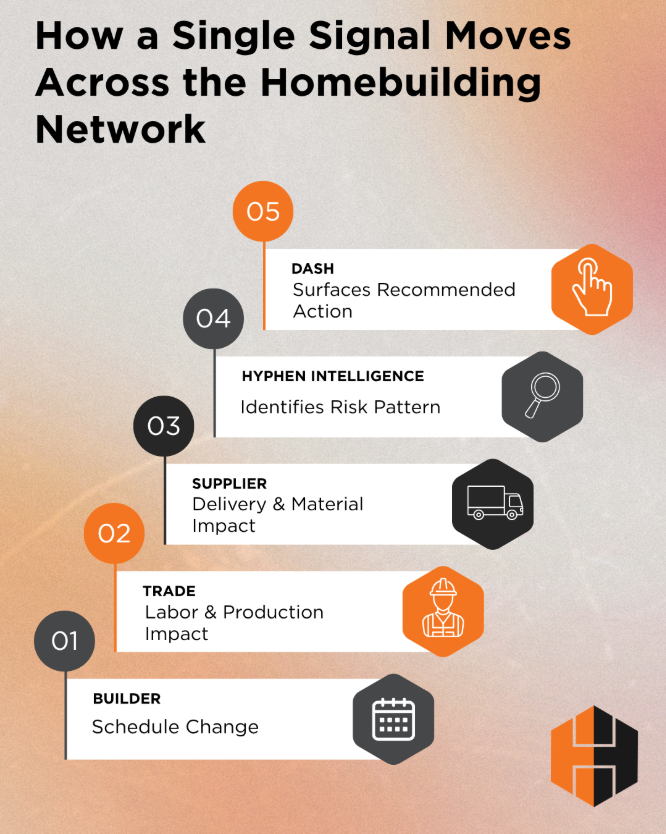
These examples highlight the value of connected information. Understanding the ripple effects is one thing; helping teams quickly access that information and act on it is another.
How Hyphen Connects the Homebuilding Network
Hyphen Solutions was built around the relationships between Builders, Suppliers, and Trades.
BuildPro and SupplyPro GM operate within the same connected environment, allowing information to move between participants as work progresses. Instead of relying on separate systems, spreadsheets, phone calls, and emails to stay aligned, teams have visibility into the scheduling, purchasing, and fulfillment activity that affects their work.
Many software providers are adding AI capabilities to systems that were never designed to connect the people responsible for building homes. Hyphen’s approach is different because Builders, Suppliers, and Trades are already working from connected workflows.
Dash, the AI assistant built into Hyphen products and powered by Hyphen Intelligence, helps teams access that information more easily. A Builder might want to know which jobs are beginning to fall behind schedule or which milestones need attention this week. A Supplier may need to understand which deliveries are at risk or which jobs have changed since yesterday. A Trade might be looking for crews that need attention or jobs that are no longer tracking to schedule.
Instead of spending time gathering updates from multiple systems, teams can quickly understand what is changing and where attention may be needed next.
What This Means for Builders, Suppliers, and Trades
While information moves across the network, the benefits show up in everyday decision-making.
Builders gain greater visibility into schedule impacts and emerging risks before they affect multiple jobs. Trades gain a clearer understanding of labor demand, workload planning, and changing job conditions. Suppliers gain earlier visibility into delivery timing, material demand, and fulfillment challenges.
Each group benefits from information that would be difficult to see when operating independently because the context extends beyond a single team, workflow, or system.
Frequently Asked Questions
A connected construction platform helps Builders, Suppliers, and Trades work from shared information rather than separate systems, improving visibility across scheduling, purchasing, and job activity.
Many AI tools operate within a single workflow. Hyphen connects Builders, Suppliers, and Trades through shared workflows, helping teams understand how activity in one area affects the rest of the build.
Connected activity creates additional context, helping teams better understand how schedules, purchasing activity, deliveries, and job progress affect one another.
Dash uses information already available inside the Hyphen Solutions’ products teams use every day, helping users quickly understand what is happening across their jobs and workflows.
The future of construction software is not about adding more features. It is about helping teams understand how work moves across the entire build.
Schedules, purchasing activity, labor, deliveries, and fulfillment are all connected. When information moves with them, Builders, Suppliers, and Trades can identify issues sooner, make decisions with greater confidence, and respond before small issues become larger disruptions.
That is the advantage of a connected network. Dash builds on that foundation by helping teams access the information they need, understand what requires attention, and keep work moving.
See how Hyphen Solutions connects your entire build network →